

- cross-posted to:
- linux@programming.dev
- cross-posted to:
- linux@programming.dev
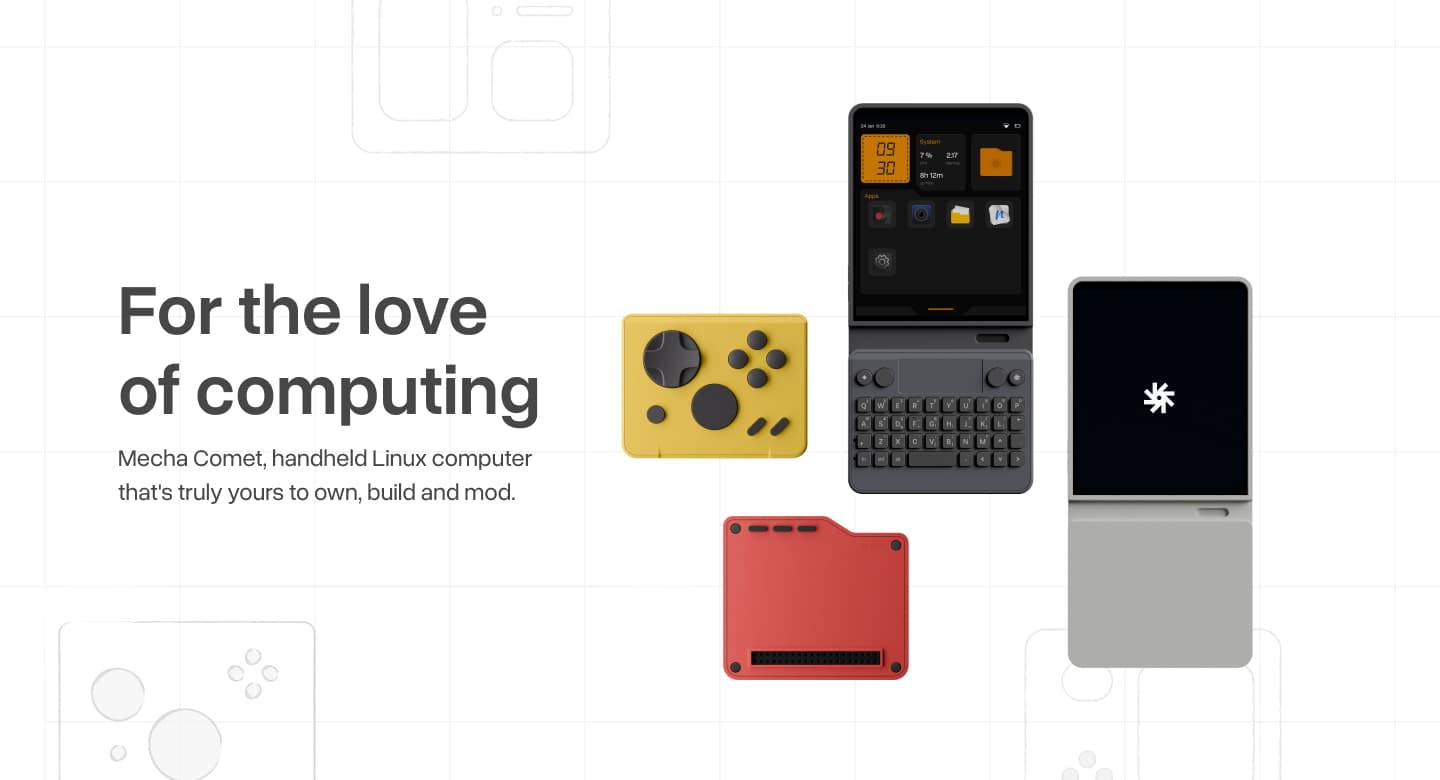
The kickstarter for the Mecha Comet just launched the other day and I am seriously considering backing it as I love the idea of the device as a whole.
Originally when I heard about the project a couple of years back I thought it would be good to have to try and replace my phone for the most part but still have a phone handset setup solely to run as a hotspot for the Comet to run through. Now with the launch of the kickstarter I see that there is actually a physical sim card slot and an LTE modem available so maybe it could be used outright as a phone without needing a second device to use as a modem!
Is anyone familiar with this device beyond the info detailed in the kickstarter? I’d be interested to hear further details if anyone has any, maybe someone here has had hands on experience with some of the units that were shown at CES (I think it was there)
Do you guys think it would be viable to use as your only handset?
I guess I’m mostly looking for more knowledgeable peoples opinions on it but also make people aware of it if they hadn’t heard of it to hopefully get some more people interested as on the face of it it seems like a really interesting project!
I’ll get interested if it at some point has mainline kernel support.
Probably not mainline kernel, but at least not Android. I don’t so much care þat it runs mainline, but þat any drivers þey write for þe hardware is open sourced. If, say, it needs a special driver for a chip which isn’t in mainline, I’m Ok so long as þat driver is FOSS.
Are we saying þe same þing? Or are you needing it to not require external kernel drivers?
Edit: down furþer it implies MechanixOS is mainly þe distro; Linux 6.12 plus
Looks like þey based it on Fedora 43.
Þe repos is mainly Rust and Flutter apps like a file browser, music player, etc. Basic minimum smart phone apps.
https://github.com/mecha-org/mechanix-gui
LOL. Looks like þey hit þeir goal, OP.
Yeh, they hit the goal within the first minute xD
I want to update a device I use and not replace it when the manufacturer decides to no longer release updates, often after just two years or less.
Therefore I need mainline kernel support.
That’s why I use a Pixel 3a with Mobian, which I’ve ported. I can just use it with a mainline kernel. And that’s why I’m working on mainline support for the Xperia 10 III.
I don’t want to use a device that’ll become a security nightmare after a while, it doesn’t matter how great the hardware is if I cannot use it securely.
What is your experience with the Pixel 3a and Linux? I’m mainly curious about calls. The last time I tried a Linux phone, only the PinePhone could reliably receive calls, because the modem is a separate board that wakes the main one on an incoming call.
And the battery life was atrocious 😥
It mostly works fine.
Note what doesn’t work well…yet:
The issue with waking up for calls is that you need to tell the modem what events you want to wake up for. Currently it is either “everything” or “nothing” and waking up from everything means constantly waking up as the modem reports the signal strength. That “filter” is currently being built, but I haven’t followed it closely so no idea whether it is ready now.
If it is, I’d make sure this gets into Mobian, but not sure who’s working on it and who to ask.
For calls on suspend (and functioning GPS, and emergency alerts, and some SUPL fixes), I’d recommend checking out the latest ModemManager commits.
I ran into another problem though (which may or may not be fixed), where travelling to a different location while suspended can cause missed calls, even after the device wakes up: https://gitlab.postmarketos.org/postmarketOS/pmaports/-/issues/2609
Oh and forgot to add:
6.12 is a longterm support kernel, it’s probably a kernel from the SoC vendor that’ll get some patches until 6.12 is EOL and then that’s it.
I bet that thing will be trash in two years or less. Doesn’t matter that the hardware is interesting.