

• 5 Posts
  • 60 Comments
Joined 2 years ago
cake
Cake day: June 20th, 2023

help-circle
  • No organization of scale works their finances like a checking account. Businesses spend money on credit, and make back it + a bit off of the results. This lets them leapfrog a business cycle and do more things now. Credit has allowed big organizations to do some really impressive things.

    So, lying a little bit, the government can get credit to do stuff now, and promise a chunk of tax revenue to the people who give it money. The US government does this with treasury bonds. Treasury bonds are sold today, with the promise that the government will pay more money later (from taxes and such). The government does stuff with this money, like maintain roads, build bridges, and improve tax collection - some of these things result in more tax money collected, so the treasury bonds were a good deal for the government. More money now has lead to more tax money later. Because the US government has been extremely good about paying back treasury bonds, treasury bonds are sold at nearly the amount they pay out. (Because of bad policy and covid, they are doing a little worse right now.)

    Why do we do this? Many alternatives would have very bad consequences. The government does so many things in the US. If they couldn’t get credit, we would get a shutdown every time the government account emptied. Because the people spending the money (executive branch employees) are not the people deciding what to buy (congress), spending and income often do not match up.

    It is also certainly more efficient than having huge organizations hoard money until they can pay for things all at once. If everyone in the market did this, we would get wild swings in the amount of dollars available (sometimes several companies would be hoarding at the same time, other times they might be spending out on new buildings all at once).


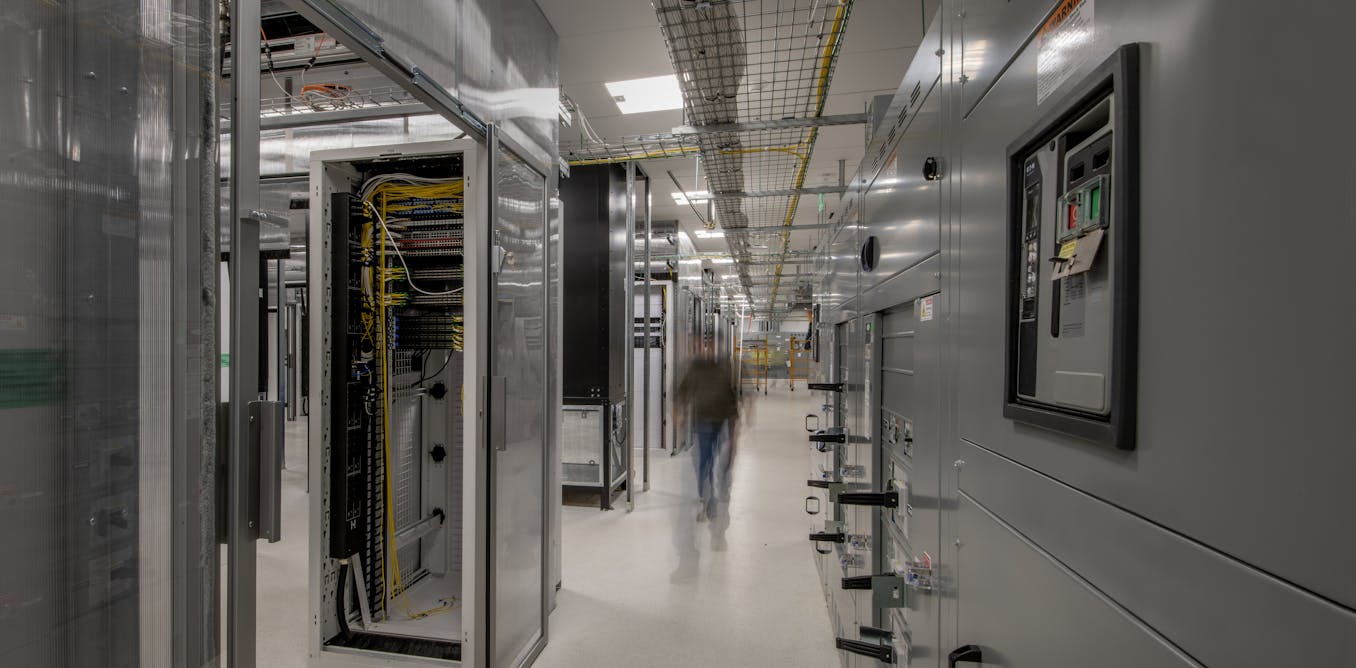
  • It is very interesting to me that we don’t make this requirement for all large power users - factories, big suburbs, etc. Because we give power companies a monopoly (but don’t put them under state control), we often let big building projects force them to expand infrastructure (and then sell access as they do). So this is a whole weird thing with capitalism meeting very regulated monopolies, in a thousand different systems cause every local has different rules.

    The thing that’s breaking our systems here isn’t that datacenters are big power users. It is that they can be built so quickly.

    I’m surprised we didn’t make ‘bring your own power’ a rule before; I guess it’s infrastructure that generally is useful for many people to timeshare, and often isn’t fully used by just one party? Factories turn off some nights, for eg. And maybe it would be bad to have multiple power providers independently pumping power out?






  • Fascinating. I see some psych studies correlating it with intelligence, but haven’t found any discussing it in a cross cultural setting. I’ll note that good irony requires sufficient context (the test stories psych studies use to evaluate this seem to be at least a paragraph). Do you know a good summary on the effect?

    Regardless, I’m pretty sure the OP is not only a play with proportional distribution, it also makes a basic math error. There’s nowhere near enough money in the US economy to make everyone a billionaire. Total assets of all us sectors are around 150 trillion = 150 000 000 000 000 (yes freedom units are weird). Redistributed to 350 million= 350 000 000 folks leaves us with less than a million per person. Fed data

    even if we correct for demographics (babies don’t need this cash quite yet), assume serious reporting errors, and I’m misreading a couple 0s somewhere in your favor, there’s still not that much money.


  • I think this might partially be a case of different uses of the word ‘burner’ - what they describe is not strong opsec, but it is a way to reduce how much you provide for free (which is often more work for the company to get). By this, I mean not providing so many photos to track your every social visit and movement, not immediately providing life updates (ie, relationships, purchases).

    Will meta find out most of this? yes. But I suspect it will be slower, more error prone, and sometimes more costly. Which don’t seem like a bad thing. Is there a good technical term for this? Hardening?

    Also, I’ll note that the point of the suggestions is to reduce noise in a persons life, not to go off the grid. I think the blog is trying to be more about curtailing and removing sources of distraction.


  • The topic is important, the timing is good (just in time for some new-years resolutions), and the writing is effective. Thank you for taking on the project.

    I had hoped that the first suggestion in part 1 would be more accessible than ‘delete the accounts and create burner accounts’ - we’ve chosen the most effective but biggest ask, and I don’t think this post quite provides the infrastructure required for many people to make the change. FB is used by many folks as social media; the keeping track of friends, events, and family can’t really be done from a burner account (your messages alone will identify you entirely to meta).

    And I have a personal pet peeve on this topic that’s triggered by the last section: I believe that mindfulness is a good way to improve internet use, but I think we’ve proven as a society that most people can’t implement this sort of self-reflection and intentionality without more structure. Where’s the tooling to remove dark patterns, automatically ask these questions after an app use, etc. ?


  • Let’s include the whole paragraph at least.

    Apertus was developed with due consideration to Swiss data protection laws, Swiss copyright laws, and the transparency obligations under the EU AI Act. Particular attention has been paid to data integrity and ethical standards: the training corpus builds only on data which is publicly available. It is filtered to respect machine-readable opt-out requests from websites, even retroactively, and to remove personal data, and other undesired content before training begins.